Microsoft Dynamics 365 is evolving rapidly. AI, Copilot, and agent-based capabilities are increasingly becoming part of the Sales experience, while Microsoft's certification portfolio is also being updated to reflect changing technologies and job roles.
Product Area:
Microsoft Dynamics 365 Sales / Power Platform / Microsoft Certifications
Tags / Keywords:
Dynamics 365
Microsoft Certifications
AI
Copilot
AI Agents
Power Platform
Certification Retirement
Professional Development
1. Context & Problem Statement
Purpose
Explain what certification retirement means for Dynamics 365 professionals and how to respond when an established certification is replaced or significantly changed.
For Dynamics 365 professionals, this creates an important question: What does certification retirement mean, and how should professionals respond when an established certification is replaced or significantly changed?
Microsoft explains that credentials are reviewed to ensure they continue to reflect relevant, real-world skills and current Microsoft technologies. A retired certification is no longer available in the certification offerings, although an earned credential can remain on a learner's transcript according to Microsoft's retirement guidance.
Recent changes across the Dynamics 365 and Power Platform certification landscape show this evolution in practice. For example, Microsoft retired several certifications during 2026, including Dynamics 365 Field Service Functional Consultant Associate, Dynamics 365 Supply Chain Management Functional Consultant Expert, Dynamics 365 Finance and Operations Apps Solution Architect Expert, Dynamics 365 Customer Experience Analyst Associate, and Power Platform Functional Consultant Associate.
At the same time, Microsoft introduced new certifications with stronger AI and agent-oriented capabilities. Examples include Dynamics 365 Sales AI Consultant Associate, Dynamics 365 Contact Center AI Engineer Associate, and Agentic AI Business Solutions Architect.
This makes certification changes relevant not only to people preparing for exams, but also to organizations planning the skills and certification roadmaps for their Dynamics 365 teams.
The perspective from the field
In an interview for this article, Nikola Tejic shared his experience of seeing this transition firsthand.
Nikola recently renewed a Dynamics 365 Sales certification after having originally taken the certification years earlier. In his view, the core Sales concepts had not disappeared. Leads, opportunities, dashboards, views, and forms were still part of the experience.
What changed was the increasing AI layer around those capabilities. As he explained, the newer certification builds on the existing Sales foundation while introducing AI capabilities into processes such as lead management and opportunity management.
This distinction is important: certification evolution does not necessarily mean that traditional Sales knowledge has become irrelevant. Instead, professionals increasingly need to understand how AI capabilities interact with the Sales processes they already know.
2. How Dynamics 365 Certification Is Evolving
Purpose
Give readers a mental model of how product evolution, AI capabilities, evolving roles, and certification updates connect, from product innovation through to continuous professional learning.
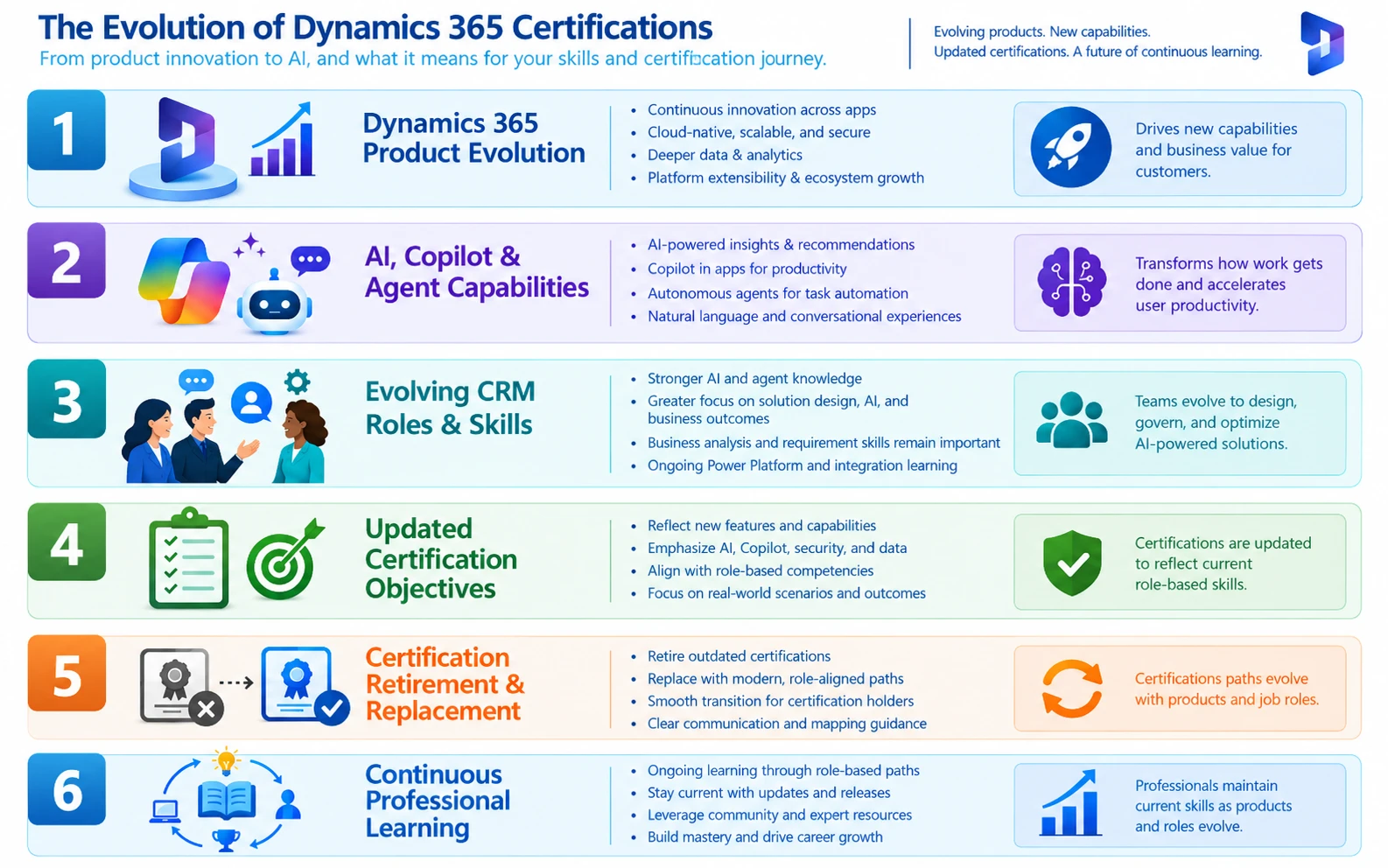
Figure 1: The Evolution of Dynamics 365 Certifications: from product innovation to AI, and what it means for your skills and certification journey
The evolution follows six connected stages: Dynamics 365 product evolution, AI, Copilot and agent capabilities, evolving CRM roles and skills, updated certification objectives, certification retirement and replacement, and continuous professional learning.
3. Understanding the Certification Transition
Purpose
Walk through a practical, step-by-step approach to understanding a certification change before starting exam preparation.
Step 1: Check the certification's current status
Before beginning preparation, professionals should check the current certification and exam information on Microsoft Learn. Microsoft provides retirement information for certifications and exams, including retirement dates.
Table 1: Certifications Microsoft lists as retired in 2026
| Certification | Retirement date |
|---|---|
| Dynamics 365 Field Service Functional Consultant Associate | June 30, 2026 |
| Dynamics 365 Supply Chain Management Functional Consultant Expert | June 30, 2026 |
| Dynamics 365 Finance and Operations Apps Solution Architect Expert | June 30, 2026 |
| Dynamics 365 Customer Experience Analyst Associate | July 31, 2026 |
| Power Platform Functional Consultant Associate | August 31, 2026 |
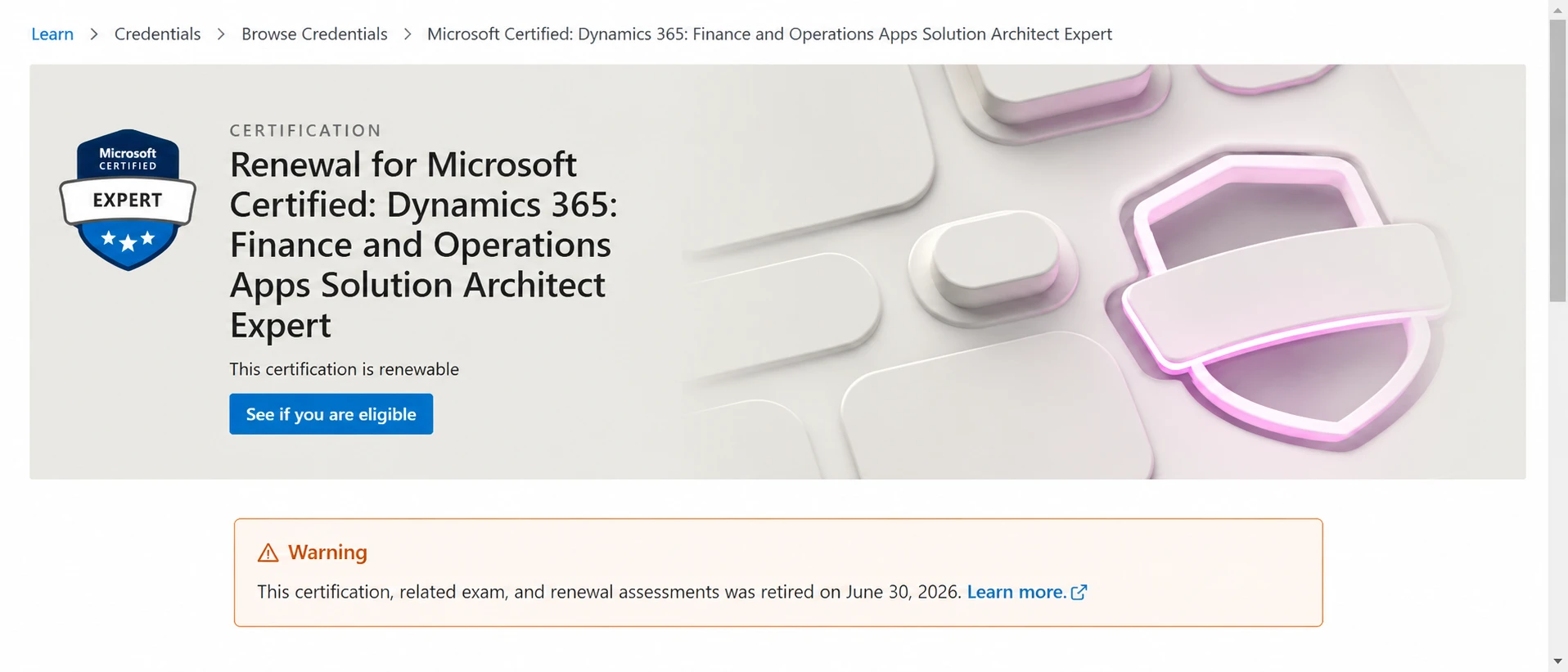
Figure 2: Microsoft Learn shows a retirement warning on the Finance and Operations Apps Solution Architect Expert renewal page
Step 2: Determine whether there is a replacement
A retired certification does not always have a direct one-to-one replacement. Microsoft's 2026 changes provide examples of both direct and non-direct replacement paths. For example:
Dynamics 365 Customer Experience Analyst Associate (MB-280) retired on July 31, 2026. Dynamics 365 Sales AI Consultant Associate (AB-210) is the current related Sales-focused certification path.
Dynamics 365 Field Service Functional Consultant Associate (MB-240) retired on June 30, 2026. Microsoft also introduced Dynamics 365 Contact Center AI Engineer Associate (AB-250) as a new certification. However, AB-250 focuses on Dynamics 365 Contact Center and AI-powered customer service capabilities rather than Field Service functionality, so it should not be considered a direct replacement for MB-240.
Dynamics 365 Supply Chain Management Functional Consultant Expert (MB-335) and Dynamics 365 Finance and Operations Apps Solution Architect Expert (MB-700) retired on June 30, 2026. Microsoft introduced Agentic AI Business Solutions Architect (AB-100) as the replacement within its updated specialization-skilling requirements, reflecting a broader shift toward AI-driven solution architecture. However, professionals should review AB-100's requirements and skills measured rather than treating it as a direct one-to-one continuation of the retired certifications.
This distinction matters because professionals should not automatically assume that every retired certification has an equivalent replacement.
Step 3: Compare the old and new certification objectives
When a certification is replaced, professionals should compare the objectives rather than simply assuming that the new exam is the same exam with a different name. The newer certification may:
Retain existing Sales concepts
Introduce new AI capabilities
Add Copilot-related functionality
Introduce agent-based scenarios
Reflect changes in the associated Dynamics 365 product
Target a different role or skill profile
Nikola's experience with Dynamics 365 Sales illustrates this pattern. The underlying lead-to-opportunity process remains relevant, but AI capabilities have increasingly been introduced into how professionals work with leads and opportunities.
Step 4: Understand the role of AI agents
AI agents are an important part of the current certification transition. During the interview, Nikola identified agents as one of the most noticeable additions to newer certification content. He cited examples from the Sales area involving opportunity and qualification scenarios.
The broader Microsoft certification changes also show an increased emphasis on agentic AI. For example, Microsoft introduced Agentic AI Business Solutions Architect as part of its 2026 skilling updates. This suggests that Sales professionals increasingly need to understand not only how a business application works, but also how AI-driven capabilities can support business processes within that application.
Step 5: Don't treat retirement as product discontinuation
Certification retirement should not automatically be interpreted as Microsoft discontinuing the underlying product. Microsoft's retirement guidance explains that credentials are reviewed to keep them aligned with current technologies, skills, and job roles. In many cases, retirement reflects a change in how current capability is represented and validated.
In many cases, retirement reflects the need to update the credential so that it continues to represent current skills. Nikola described this as similar to product evolution: as the product changes significantly, the certification representing that product also needs to evolve.
Step 6: Build continuous learning into professional development
One of the practical challenges Nikola identified is finding enough time to keep up with certification changes while working on active projects. His recommendation was to establish a consistent learning routine rather than waiting until an exam is approaching.
For example, professionals could reserve approximately one hour to one and a half hours during the morning or afternoon for learning. That time could be used to:
Complete Microsoft Learn modules
Review current certification objectives
Study new product capabilities
Explore AI and Copilot features
Follow relevant Microsoft announcements
Prepare for certification renewal
The broader lesson is to treat certification as part of ongoing professional development rather than as a one-time activity.
4. Limitations & Best Practices
Purpose
Highlight the common assumptions to avoid when a certification is retired or replaced.
Certification retirement has multiple causes
It is tempting to associate every certification retirement with AI, but Microsoft's own guidance identifies several possible factors:
Changes in technology
Changes in associated job roles
Product changes or deprecation
Changes to certification structure or instructional design
AI is clearly an important theme in several 2026 certification changes, but each retirement should be evaluated individually.
Do not rely exclusively on older preparation material
When an exam is approaching retirement or has recently been replaced, older preparation resources may not reflect the latest product capabilities. Professionals should verify:
Current exam status
Current skills measured
Retirement date
Replacement certification
Current Microsoft Learn learning paths
Understand the difference between certification and product evolution
A certification represents a set of skills at a particular point in time. The underlying Dynamics 365 product can continue evolving independently. Therefore, a certification retirement does not necessarily indicate that the associated product is no longer relevant.
Maintain broader consulting skills
Nikola emphasized that certification is only one component of professional development. For functional and technical consultants, he highlighted the importance of:
Communication
Requirement gathering
Understanding the bigger picture
Consulting skills
Understanding how individual features contribute to the overall solution
These skills remain relevant regardless of how certification names or exam codes change.
Follow reliable sources
As the pace of Microsoft product releases increases, professionals can encounter a large amount of information from different sources. Nikola recommended following trusted people and reliable industry sources rather than attempting to consume every piece of information available.
5. Real-World Example
Purpose
Show how a traditional Sales certification compares with its AI-enhanced successor, using Nikola's own experience.
From traditional Sales certification to AI-enhanced certification
Nikola originally took a Dynamics 365 Sales certification approximately ten years ago and continued renewing it over time. When he recently took the newer version, he initially prepared only about a day and did not pass. After reviewing the areas that had changed, particularly the AI-related content, he spent additional time studying and subsequently passed.
His experience allowed him to directly compare the older and newer certification approaches. The fundamental Sales concepts remained familiar. The major change was the additional AI layer surrounding those processes. This example demonstrates why professionals with years of Dynamics 365 experience may still need to actively learn new capabilities when certification content changes.
Organizational upskilling
The transition also has implications for organizations. Nikola explained that certification planning should ideally be part of a broader organizational skills roadmap. He recalled that while working at Microsoft, certifications were aligned with individual roles. A functional consultant, for example, could have specific certification expectations based on their area of responsibility. This type of structured approach can help organizations:
Identify required skills by role
Plan certification paths
Track renewal requirements
Incorporate emerging AI capabilities into learning plans
Maintain a current Dynamics 365 skills base
6. Key Takeaways & Resources
Key Takeaways
Dynamics 365 certifications are evolving alongside the products they represent.
AI, Copilot, and agents are increasingly visible in Microsoft's newer certification landscape.
Certification retirement does not automatically mean that the underlying product is being discontinued.
Microsoft identifies several reasons for retirement, including technology evolution, product alignment, and certification-design changes.
Not every retired certification has a direct one-to-one replacement.
Professionals should check Microsoft Learn for current certification status, retirement dates, and replacement options before beginning exam preparation.
Core Sales knowledge remains important, while AI-related skills are increasingly becoming part of the professional skill set.
Continuous learning is becoming more important as Microsoft releases product capabilities at a faster pace.
Communication, requirement gathering, and broader consulting skills remain important alongside technical certification.
Looking Ahead
The certification landscape continues to evolve.
Nikola expects AI to become increasingly integrated into Dynamics 365 certifications. While the exact form of future AI capabilities is difficult to predict, the direction visible today includes increasing emphasis on AI, Copilot, and agents. Microsoft's 2026 certification changes provide concrete examples of this direction, including new credentials focused on AI-powered Dynamics 365 roles and agentic AI.
For Sales professionals, the practical takeaway is not to abandon traditional Sales expertise. Instead, professionals can build on that foundation by continuously learning how AI capabilities are changing the way Sales solutions are designed, configured, and used.
Recommended Resources

Sareena Shahid |

Posted on: October 2026